This week's Friday Photo is a copy of a line drawing of 'Coriolanus' a 3 masted iron ship, built by Archibald McMillan & Son in Dumbarton. It was built in 1876. This lovely plan, found by our volunteer Craig Osborne, is part of the Phil Thomas collection. Below are some images of the ship, where the detail on the plans can be clearly seen. The ship was laid up in 1932.
The crucial role of female workers within the shipping, manufacturing, and engineering industries has become more visible recently with campaigns and online content created by University of Glasgow Archives and Special Collections, Glasgow Women’s Library, Go Industrial, Inverclyde Shipbuilding and Engineering and Imperial War Museum alongside other institutions that seeks to understand, identify and raise awareness of the important role women played within Scotland’s Industrial history.
My initial inspiration to write a blog post focusing on 'Women at Work’ came after conversations with colleagues on females working in the shipyards and in engineering firms which led me to find out more about the role of female tracers. The image above is of the tracing department at Fairfield’s Shipbuilding and Engineering Company in Govan c.1909.
Female tracers worked in the drawing offices and traced over the drawings made by draftsmen to make the final original design. The need for tracers is often put down to the increased demand for engineers, however it was mainly down to the fact that women were able to trace over these plans with care and precision, it took great skill to be able to become a tracer.
To become a tracer, you would have to complete an apprenticeship in a tracing office. The length of these apprenticeships seems to vary between companies but range from nine months to five years. The tracing offices were made up of female employees who were very much kept separate from their male colleagues or draftsmen.
The above image shows the drawing office where draftsmen would have completed their plans before sending them though to the tracers. Despite men and women being kept separate both workrooms are similar in layout and there aesthetic. This image was also taken at Fairfield’s Shipbuilding and Engineering Company in Govan c.1909.
I was fortunate enough to be put in contact with Ann Wilson who had previously completed a nine-month apprenticeship with Loudon’s engineering shop in Paisley and had then gone on to work with the G.P.O (general post office) for 29 years as a tracer. In this blog I have recounted her time spent as an apprentice and then as a tracer to give more information on the job and what was involved.
Tracers worked solely with ink and linen cloth. Once the cloth had been stretched using four pins, chalk was rubbed into the warp and weft of the linen and left overnight. In the morning the plan drawn by the draughtsman would be slid under the cloth and then weighted. In shipbuilding, plans came in two different sizes; 32” and 46”. Tracers would sometimes work together to complete a drawing if necessary.
The use of linen, as Ann recalls, was a difficult material to work with. Using chalk before applying the ink would provide a surface texture making it easier to apply. The tools used were also the same tools used by draftsmen. If too much ink was placed into the pen it would run onto the linen and spoil the drawing. However, the time it took for the ink to dry would have been minutes as it was applied finely onto the linen. The boards used were tilted at an angle towards the tracer, an office could have up to twenty tracers working in the offices at one time. These boards could be adjusted and set flat depending on the need of the tracer. Set-squares, straight edges and curves were all crucial parts of the tracer’s toolkit, often straight lines were drawn first with corners added in afterwards.
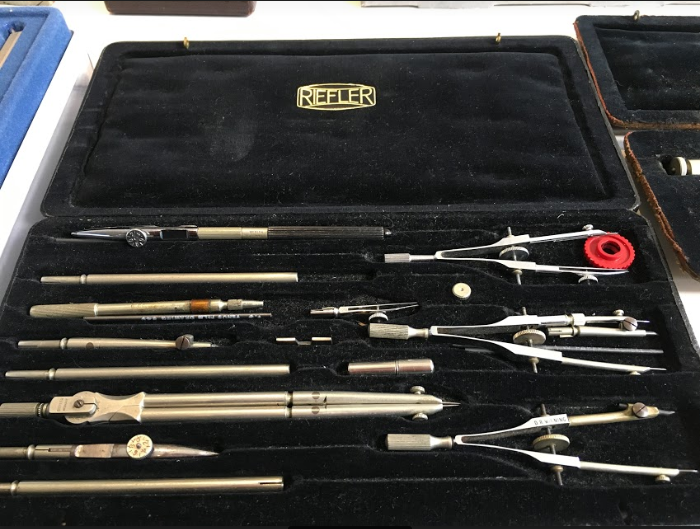
We were also fortunate to find some tracers tools which had belonged to Duncan Winning. These would have been used by both draftsmen and tracers.
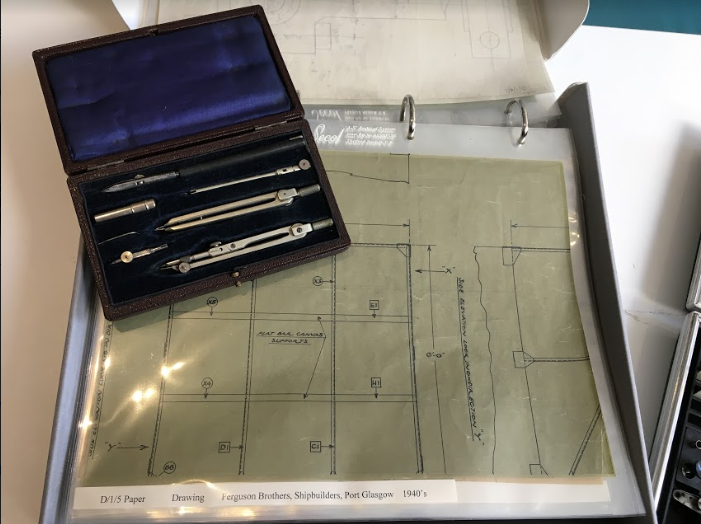
One of the most useful resources at The Trust is a folder compiled by Duncan for the National Records of Scotland which documents the different types of materials that would have been used for plans. This folder is an invaluable resource when cataloging large rolls of plans made up of different types of material, for example; plastic, cartridge, paper and linen. The image below shows a paper drawing from Ferguson Brothers Shipbuilders, Port Glasgow next to a set of tools that a tracer would have used to draw a similar plan.
Not every plan was simply a straightforward copy, at times tracers were required to add in adjustments or alterations, this included making one drawing from multiple plans; each dependant on what the individual order demanded. Many drawings required different levels of detail which the tracer would build upon until the full drawing was completed.
Thanks to Ann Wilson and Craig Osborne our volunteer for sharing their knowledge on the work of female tracers.
Links and References
- The Girls Own Paper, 1880-1907 ed. Terri Doughty. Broadview Press, March 2004.
- Go Industrial, Women at Work on the Clyde blog post.
- Go Industrial Collections.
- A Girl's Career, Glasgow Women's Library.
- WW1 - Women in Shipbuilding. Inverclyde Shipbuilding and Engineering.
- The Women's Work in the Transport Services, Imperial War Museum Collections.
- A Day in the Life of a Munitions Worker, Imperial War Museum.
- The Glasgow Story, Drilling at Linthouse Shipyard. Image from Glasgow University Archive Services.
- Women's History Scotland.
- Scottish Archives for Schools, The Role of Women in Industry.
Having watched the Waverley pass by my house for many years, it is one of the most distinctive memories I have of growing up on the Clyde. Often seeing ships, boats and tugs of all kinds sailing past, bound for unknown destinations. The Waverley in particular was a regular sight and one which, as a child, I could easily spot with its distinctive black, white and bright red funnels. It therefore seemed appropriate to be the first in our new series of 'monthly favourites' on the blog. As the Waverley sails between April and October each year, it also serves as a reminder that spring is here and that summer *fingers crossed* is not much further away!
Named after Sir Walter Scott's first novel, the Waverley was built by A&J Inglis of Pointhouse in 1947 and is the last sea-going paddle steam engine in the world. Ending her working career for the London and North Eastern Railway in 1975 the Waverley has since been in operational preservation, offering regular trips on the Clyde, the Thames, South Coast of England and the Bristol Channel.This picture is part of our Dan McDonald collection, which contains over 6,500 images of boats and vessels along the Clyde and the west coast of Scotland between 1920 and 1980.
The importance of paddle steamers is reflected in the story of the Waverley, famously gifted to the Paddle Steamer Preservation Society for £1. Not only did paddle steamers hold a crucial place in coastal passenger and excursion trade, they also made a significant contribution to the war effort as minesweepers in both World War 1 and World War 2. The Waverley was built to replace the previous Waverley which played an important role at Dunkirk in 1940.
The first Waverley was built in 1899 also by A&J Inglis. This particular image is part of the Lind collection, made up of Bill's personal collection of ship plans, photographs and postcards. The original Waverley was requisitioned during the first World War and deployed as a minesweeper in 1915. During the evacuation at Dunkirk in 1940 the boat was sunk during an air attack.
In 2003, a large-scale restoration project began to return the Waverley to its original 1940's style. All made possible by funds from National Heritage Lottery Fund, PSPS with contributions also coming from Glasgow City Council, Scottish Enterprise Glasgow, the European Regional Development and local authorities. Not to mention the countless number of devoted volunteers and specialists who all contributed to the successful completion of the project. This important restoration re-affirmed the Waverley's importance within Scottish Heritage and paddle steamers as being of national significance.
These images provide a way of understanding Scotland's shipping industry whilst providing accessibility through digitisation of these images.
References and useful links.
This week
our #ArchiveZ tag was 'H' in the alphabet and it seemed only
appropriate to document the move of the Trust to its current
headquarters in Johnstone. On this day 26 years ago, archival work
commenced at the Ballast Trust's new headquarters in Walkinshaw
street, Johnstone. The move was completed earlier in March 1992, a
task which took 3 days!
Prior to
moving to Johnstone, the Trust had initially operated from Bill's
base at Malcolm's of Brookfield, however this was only a temporary
arrangement. The liquidation of Scott Lithgow shipyard saw the Trust
begin a large-scale operation to rescue and list the huge volume of
commercial and technical papers of the inoperative organisation. The
task was of such a scale it was agreed that all surviving records of
constituent companies would be centralised in the former Joiner's
Shop in the Kingston Yard. It was through this operation that the
Ballast Trust were able to secure a new headquarters for the next 3
years and 8 months, from 29th July 1988 to 19th
March 1992.
This is
part of a letter written by Bill to Henry Higgs, giving an update on
the move to Scott Lithgow's Joiner's Shop in Port Glasgow from the
offices in Brookfield. Dated 17th December, 1988.
Reference No. UGD 301/1/20/120.
This is a letter written by Bill to George Mackenzie at the Scottish Record Office. This is a progress report on the move and subsequent activities in Port Glasgow. Dated 12th August, 1988. Reference No. UGD 301/1/20/65.
This is
correspondence between George Mackenzie at the Scottish Record Office
and Bill Lind. Bill highlights the plan for Scott Lithgow's and gives
dates when the Trust would be ready to move to Port Glasgow. Dated
30th June, 1988. Reference No. UGD 301/1/20/49.
It was in
Port Glasgow that the working practices of the Ballast Trust
developed and the value and importance of its service came to be
fully understood and acknowledged. The enormity of this task is
apparent in Bill's correspondence, where he estimates over 120 tons
of material was collected from Scott Lithgow's and was brought to the
Joiner's shop for processing. This process culminated in a rich
collection covering a period of 120 years, including written
communication about the building of blockade runners on the Clyde
during the American Civil War, photo albums and a series of yard
manager diaries. These records were then transferred to the Scottish
Business Archive at the University of Glasgow by Glasgow University
Archive Services.
The
successful arrangement at Scott Lithgow also helped to secure the
agreement of Kvaerner Kincaid of Greenock, to clear the vast quantity
of commercial and technical records from their premises. A similar
set-up to Scott Lithgow was granted and Kincaid's allowed the Trust
access to the mould loft of the former shipbuilders. At this point
the Trust was operating from two independent locations
simultaneously.
However,
this came to an end in 1991, when Trafalgar House notified the Trust
of its intention to demolish the Joiner's Shop and clear the site at
the Kingston Yard. A new search for permanent premises led the Trust
to its present base in Walkinshaw Street, Johnstone.
The move
to Johnstone was a gargantuan task, which required two teams at the
Kingston Yard and at Kincaid's along with help from personnel at the
Scottish Records Office (now known as National Records of Scotland)
and Strathclyde Regional Archives (now known as Glasgow City
Archives) and students from Professor Slaven's Department of Economic
History in the University of Glasgow. The move began on the 16th
March 1992 and was completed by the 19th March 1992.
This
image shows the outside of the Trust in 1992. Ref UGD 301/6/3/8.
This
image is of Bill Lind in his office at the Ballast Trust, now the
office for our Archivist and Surveying Officer. Ref UGD 301/6/3/8.
This image
is of our central work area before any of the shelving was added. Ref
UGD 301/6/3/8.
This is correspondence between Bill Lind and Duncan Haws, Travel Creators
Ltd. explaining the Trust. Dated 8th March, 1994.
Reference No. UGD 301/1/26/35.
The premises
at Walkinshaw Street, previously a furniture factory of James E.
Robertson and Sons Ltd. suited the purposes of the Trust well.
Between 1992 and 2007 this was where Bill was able to shape his
personal vision for the trust and what was required to identify, list
and catalogue technical records in order for them to be accessible
and understandable to everyone.