This week's Friday Photo is a copy of a line drawing of 'Coriolanus' a 3 masted iron ship, built by Archibald McMillan & Son in Dumbarton. It was built in 1876. This lovely plan, found by our volunteer Craig Osborne, is part of the Phil Thomas collection. Below are some images of the ship, where the detail on the plans can be clearly seen. The ship was laid up in 1932.
This week, we have a beautiful three-masted iron sailing ship from the Dan McDonald Collection, the 'Earl of Zetland'. Like most of the glass negatives in this collection, this particular ship was built on the Clyde, at Archibald McMillan & Sons yard in Dumbarton in 1875. She is recorded as carrying many immigrants to Australia and New Zealand, with one group of immigrants being 'without a single dissentient...fully satisfied' (although one went mad during the voyage...).
As an ocean-going 'windjammer', she and her crew would have had to endure the most treacherous seas, and it is very likely that she would have lost several crewmen over the course of her career in accidents. According to the South Australia Maritime Museum, most of the officers and crew apparently went mad during a voyage from Sourabaya to San Francisco, for reasons unexplained. She was wrecked in 1905 at Vang near Hasle, Bornholm while carrying a cargo of timber. It isn't known if the crew survived.
~ William Brown, Volunteer
This week's Friday photo is one of the glass negatives from the Dan McDonald collection, which was digitised earlier this week by one of our volunteers, William Brown. The Dan McDonald collection is permanently held with the Trust and was bought by Bill Lind in 1996. The collection contains over 6,500 images of ships, vessels and places along the Clyde and west coast of Scotland (c.1920-1980).
This particular negative is of 'Glenclova' a steel sailing vessel 4 Mastered Barque in the Tasman sea, a little further afield than the Clyde and west coast of Scotland! This ship was built by Charles Connell & Company, Glasgow in 1893. This isn't one of Dan's own images but one that is part of his larger collection.
This week's photo is from Bill's extensive postcard and photograph collection. This postcard is of paddle steamer 'Waverley' sailing around Lundy island on one of her voyages during the summer months!
As the weather today is lovely and sunny, this image seemed like an appropriate choice!
Photo credit to Ian Muir. Coincidentally we have some of Ian Muir's slides at the Ballast Trust which are in the process of being listed and homes sought for them.
This week's photo is of Albert Harbour in Greenock. Particularly interesting as you can see the Greenock Town hall in the distance. The foundations for the harbour were laid in 1862, replacing the earlier Albert Quay.
The Lind Collection held at the Trust also holds an image of Countess of Breadalbane & Talisman which was photographed in Albert Harbour, May 1967. You can view this image here on our Flickr account.
You can find more images and information on Albert Harbour here.
Bill Lind was a ship enthusiast and built up a large personal collection of plans, photographs, and postcards. This week’s photo is of tanker ‘Stolt Norness’ built by Boelwerf (c.1970) in Temse, Belgium. This image comes from Bill’s personal postcard collection, an important and invaluable resource for us when answering enquiries and carrying out research into ships. She was sold in 1977 and again in 1982 and renamed ‘Turpial.’
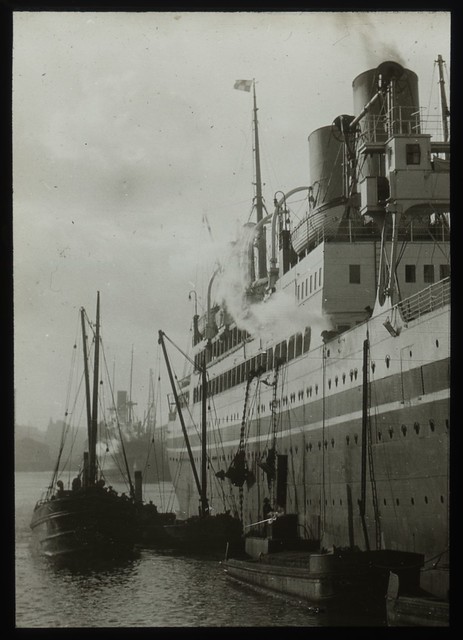
New merchant navy and warship images have been added to our Dan McDonald collection on Flickr, including this image, which shows the S.S. Melita being re-fueled with coal in 1924.
Built by Barclay, Curle & Co, Whiteinch in 1918, the Melita was originally intended for the German Hamburg-America Line (HAPAG), but at the outbreak of World War I the unfinished ship was sold to Canadian Pacific Railway Ocean Lines. Her main engines were built by Harland and Wolff, Belfast, who subcontracted her maiden voyage in January of 1918 from Liverpool to St John. At 13967 tonnes, and 520 ft by 67.2 ft, she was built to be a passenger ship, but was requisitioned by the Royal Navy as a troop ship to transport American soldiers to Europe. After the War, she helped return American and Canadian soldiers back across the Atlantic and German P.O.Ws back home before being placed on the Liverpool-Montreal run and the Antwerp-Southhampton-Montreal run.
After the Great Depression, the Melita was re-purposed as a cruise ship, travelling to the Canary Islands and the Mediterranean before being sold for scrap. Avoiding this fate, she was bought up by the Italia Line in 1935 and renamed the Liguria. She took part in the mass emigration initiative under Mussolini and transported Italian settlers to Libya, but was largely being used as a troop ship when she was scuttled in January 1941. Nine years later, she was raised and scrapped.
Thanks to this site, which provided much of the information for this post.
Olivia Howarth, archives trainee.
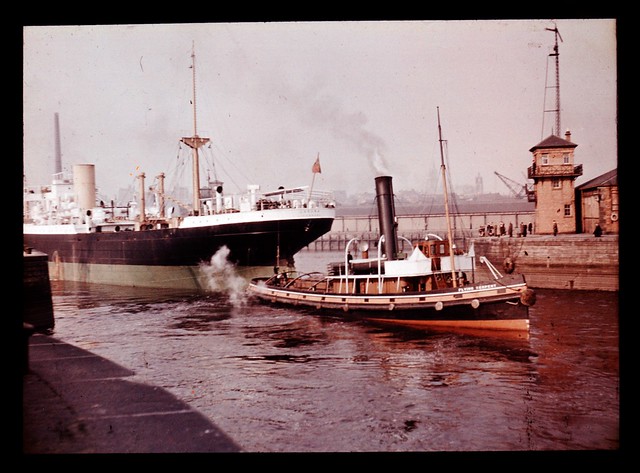
More images have been added to our Dan McDonald collection on Flickr, including this one of the tug Flying Serpent pulling the cargo ship Laguna into port at the James Watt Dock in Greenock.
The Flying Serpent was built by Ferguson Shipbuilders and launched from their yard at Port Glasgow on 16 March 1909 and then completed in 1911. It was owned by the Clyde Shipping Company and it's job was to pull large ships and help them navigate the bends in the River Clyde, ensuring that they kept to the deep channels. In it's lifetime it guided many ships including the Cunard Line's famous ocean liner the Aquitania. In May 1914, together with tugs the Flying Buzzard, Flying Falcon, Flying Linnet, Flying Cormorant and the Flying Swallow, the newly built Aquitania was pulled from John Brown's Shipyard at Clydebank, down river into the deeper waters of the Clyde Estuary, from where it went on course to Liverpool for it's maiden voyage to New York.
In the above photograph the tug is pulling the 6,466 ton, 420 foot long ship Laguna, which was built at the Harland & Wolff shipyard in Govan. It was launched on 19 April 1923 and completed in July the same year. The Laguna was a cargo ship owned by the Pacific Steam Navigation Company Ltd., Liverpool and like many cargo ships, was important in transporting essential supplies to the UK from America during the second world war. On the 31 May 1942, the Laguna picked up 17 survivors who had been adrift in a lifeboat for 3 days after their merchant ship the Yorkmoor had been sunk by a German U-Boat about 530 miles east of the Florida coast. Less than 3 months later the Laguna itself was torpedoed by a U-Boat. It was part of a convoy and was carrying cereals, cotton, hemp and ore from Cristobal in Panama to Liverpool, and was west of Haiti when it was hit. Two of the ships in the convoy were sunk but luckily the Laguna was only damaged and all the crew survived. It was towed to Guantanamo where it was repaired and returned to service in November 1942 and continued in working service until it was scrapped in 1952 at Barrow in Furness. The Flying Serpent outlasted it, being sold to Ybarrola Depositos Aceite Conbustible SA, Ceuta, in 1947 and ending the final 12 years of it's life in Spain.
Have a look at the other interesting images of our shipping heritage in the Dan McDonald Collection.
Kirsty Menzies, Volunteer
Several photographs from the William Lind Collection (held at the Ballast Trust) have been digitised and added to our Flickr account. The recent updates include two photographs of the S.S. Columbia, pictured below.
The S.S. Columbia's eventful history tells a tale of the increasing popularity of transnational travel and of conflict between world powers at the turn of the century.
Built for the Hamburg American Line by Laird Brothers of Birkenhead in 1889, the ship was sold to the Spanish government in 1898 for use as a troopship in the Spanish-American War. During its time under Spanish ownership it was named "Rapido". One year later it was sold back to the Hamburg American Line and returned to its original name. The Columbia was then sold to the Russian Voluntary Fleet in 1904, becoming the cruiser "Terek". It was used for troop transport during the Russo-Japanese War, before being scrapped in 1907.
You can view the merchant shipping album, and many other fascinating images, by clicking the link to our Flickr page below.
~ Joseph Heffernan, Volunteer
I am currently volunteering at the Ballast Trust where I have begun scanning and uploading some of the merchant shipping photographs held at the Ballast Trust from the William Lind Collection.
The picture below depicts one of the photographs from the William Lind collection.
This is the S.S "Amerika" built by Harland & Wolff, Belfast, in 1905. Her story begins in 1910 where "Amerika" was the first ship to carry an extra-tariff restaurant, created by Charles Mews's of Ritz Carlton fame.
In 1912 she transmitted an iceberg warning just hours before the RMS Titanic struck the fatal iceberg that caused it to sink. In 1914, with the outbreak of WW1, "Amerika" hid in Boston util the Americans entered the war where she was renamed "America", and carried troops across the Atlantic.
Check out the Ballast Trust's flicker account for more photographs and other interesting stories by clicking the link here.
~ Joanne Savage, Volunteer
Between 1834 and 1961, there were 23 Clyde-built ships which were given the name Victoria; nine of these were paddle steamers.
This is one of them.
I believe this is the 1886 Victoria, built by Blackwood and Gordon, of Paisley and Port Glasgow.
This Victoria went on fire on 17th September, 1893, while lying at the Broomielaw in Glasgow. The fire-brigade had to use two small ferryboats in fighting the fire, and a great deal of damage was done. The ship then spent a few years working on the Thames before returning to the Clyde, and was ultimately scrapped in 1900.
Of the eight other paddle steamers named Victoria: one has no location given; two were owned by the Alloa, Stirling & Kincardine Steamboat Company; one worked in Aberdeen and Newcastle, and later in Portugal; one sailed on Lake Lucerne; one worked in Australia, and later in Japan; one worked along the south coast of England; and one sailed the Channel crossing from Newhaven to Dieppe, and was wrecked in 1887 due to fog, with the loss of 19 lives.
And that's not mentioning the ships named Princess Victoria, Queen Victoria, or Royal Victoria...
Today's photo is one which caused me some confusion this week! I'm the Project Scotland volunteer who's been scanning old photos of paddlesteamers. Usually, after scanning a photograph, I look up the ship in one or two places, such as the Clydebuilt database, and find a little information to put on our flickr. Not this one, however.
It looked to me like a very early paddle steamer, and I was quite put out at not being able to find anything. At first I thought the name written beside it was wrong - the second word didn't look like Maid to me - but my eyes deceived me, and Scottish Maid was indeed the name. Staff member Duncan took a look as well, and he recognised that the photograph was taken from Gourock Pier, with Kilcreggan in the background.
Unfortunately for my searching, Scottish Maid is also the name of the first clipper ship, and she dominated the initial search results.
One item caught my eye, though: a genealogy forum. The original post was from an Australian, looking for information on his great-great-grandfather from Port Glasgow, who was lost at sea. Further down the page was a paragraph from the Glasgow Herald about that very man's death in 1863 after falling from "the Tug-Steamer Scottish Maid" in Port Glasgow harbour. Port Glasgow is not very far from Gourock - surely it was the same boat?
Searching for "Scottish Maid tug" brought me immediately to Tyne Tugs which lists four tugs under the name; but only one of them was registered at Port Glasgow.
So, this is - most likely - the wooden tugboat Scottish Maid, built by J Dowey of North Shields, in 1846. She was registered at Port Glasgow in 1853, and stayed on the Clyde until she was broken up in 1873.
Update: New information has come my way, that another of those four tugs was based at Greenock from 1877 to 1892. This was the Scottish Maid built in Gateshead in 1856.
Simply thinking about the development of photography, it's probably more likely to be the later boat; we may never know for sure...
Today's Friday photo is the paddlesteamer Premier.
Built by William Denny and Brothers in Dumbarton, in 1846, she was first owned by the Dumbarton Steamboat Company. She was bought by John Tizard of Weymouth, and then by Cosens and Company, and worked for them for over 70 years. Before her scrapping in 1938, she was said to be the oldest paddle steamer afloat anywhere in the world.
This week's Friday photograph is an unusual view of the P.S. Meg Merrilies, second of that name.
This ship was built for the North British Steam Packet Company in 1883, by Barclay Curle & Company of Whiteinch. Unfortunately, she was considered too slow and returned to the builders after one season. She was sold to Captain Campbell of Kilmun, subsequently to the Caledonian Steam Packet Company, and finally to the Leopoldina Railway Company, for service in the harbour of Rio de Janeiro.
She left the Clyde in 1902, and the image seems to show her boarded up and ready for an Atlantic adventure.
There's another shot on flickr of her leaving Kilcreggan pier.
One for the start of the summer holidays this week! We uploaded this fab image of the Duke of Devonshire paddle steamer a couple of weeks ago to our flickr photostream. The ship was built by R & H Green, Blackwall, 1896.
There is more information about her on this website.
Our image shows her at Lulworth Cove and I also realised this week via twitter that there are a few videos of her coming into the cove on youtube.
There is more information about her on this website.
Our image shows her at Lulworth Cove and I also realised this week via twitter that there are a few videos of her coming into the cove on youtube.
This week's photo is of the ps Lucy Ashton. She was built in 1888 by Thomas B Seath of Rutherglen, and owned by the North British Steam Packet Company, first working on the Holy Loch service and later steaming between Craigendoran and Gareloch.
She made her final run in February 1949. After that, she was sold for experimental use by the British Research Shipbuilding Association, during which she was stripped to the hull and fitted with jet engines. She was finally scrapped in 1951.
The name Lucy Ashton comes from Walter Scott's historical novel, The Bride of Lammermoor.
More great images have been added to flickr this week by our volunteer, Ruth. Including this wonderful image of the paddle steamer Industry, built by William Fife of Fairlie in 1814.
Fittingly as we're heading off to the opening of the refurbished Scottish Maritime Museum site at Irvine this afternoon, they also have a copy of this image up on their flickr site here with lots of information about the career of PS Industry.
Today's photo is from the Bill Lind collection, and is of the ps Duchess of Hamilton taking on some choppy seas. She was built by William Denny and Brothers, Dumbarton, for the Caledonian Steam Packet Company.
The Duchess of Hamilton was the first vessel fitted with a Parsons turbine, which generated electricity for lighting. She was commandeered by the Admiralty as a minesweeper during WWI, and sunk by a mine near Harwich, on the 29th November 1915.
Today's photo is from our Dan McDonald Collection and is of the TS Queen Mary II. She was built by William Denny and Brothers, Dumbarton for Williamson-Buchanan in 1933.
This image appears on the last page of our history which was posted out this week and published online here. It was chosen to go opposite the page with details of all the many volunteers who have worked with the Ballast Trust over the years and who we'd like to say a big thank you to!!
We're finishing up here at the Ballast Trust for the holidays this afternoon. For our final photo of 2012, I'm very happy to share this Christmas card that we found in amongst some of Bill's odds and sods of headed notepaper and supplies of blank stationery.
It was an official Christmas card for British Shipbuilders who were the nationalised company that owned and operated British shipyards from 1977 until the late 1980s.
You may have already seen the image on the Scottish Council on Archives website as part of their Christmas in the Archives feature.

We will be closed for the Christmas and New Year holidays from Friday 21st December 2012 to Monday 7th January 2013 (inclusive).
It was an official Christmas card for British Shipbuilders who were the nationalised company that owned and operated British shipyards from 1977 until the late 1980s.
You may have already seen the image on the Scottish Council on Archives website as part of their Christmas in the Archives feature.
We will be closed for the Christmas and New Year holidays from Friday 21st December 2012 to Monday 7th January 2013 (inclusive).