This week's Friday Photo is a copy of a line drawing of 'Coriolanus' a 3 masted iron ship, built by Archibald McMillan & Son in Dumbarton. It was built in 1876. This lovely plan, found by our volunteer Craig Osborne, is part of the Phil Thomas collection. Below are some images of the ship, where the detail on the plans can be clearly seen. The ship was laid up in 1932.
New puffer images have been added to our Dan McDonald collection on Flickr.
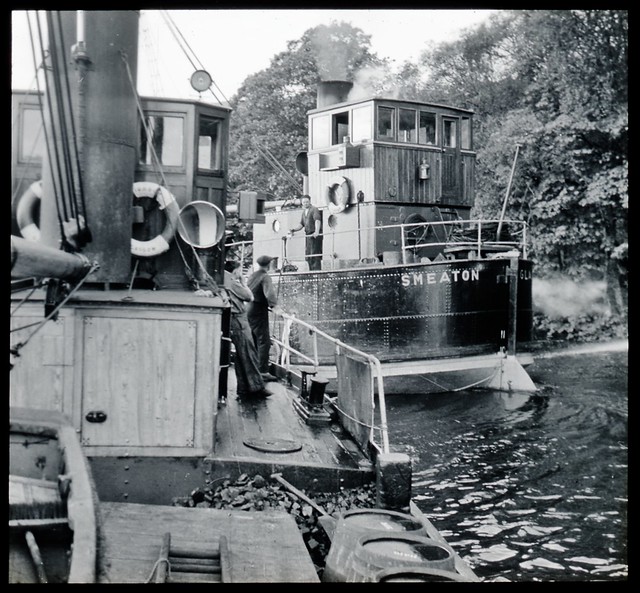
This one is of two puffers, the Pibroch and Smeaton, passing each other on the Crinan Canal and crew members taking the opportunity to have a break and a chat.
The Pibroch, the older vessel of the two, was built by Scotts of Bowling in 1923 for Mackie Brothers who owned the White Horse Distillery at Lagavulin. The barrels in the foreground hint at the precious cargo the Pibroch carried from Islay to the Clyde docks by way of the canal. For 34 years she transported coal and barley to the distillery and then loaded up with barrels of whisky to be shipped to the mainland. In 1957 she was replaced by a new motorised vessel, also the Pibroch, and was sold to Duncan MacCorkindale of Troon, who renamed her Texa. After 3 years she was sold to McNeill of Greenock and then in 1964 to Burke of Greenock when she was given another new name, Cumbrae Lass. She was broken up the Arnott Young yard, Dalmuir in 1965.
Less is known about the Smeaton. She was built by Pimblott of Northwich in 1944 as a Victualing Inshore Craft (VIC) for the Ministry of War Transport and named VIC 33. She carried out work for the war effort and then in 1947 was transferred to the army and then sold to the Mersey Docklands and Harbour Board and renamed Smeaton. At the time this photograph was taken she was owned by Warnock Brothers, a sand dredging company in Paisley. She was later brought by H G Pounds of Portsmouth but nothing else is known of her after 1965.
My thanks to the Clyde Maritime Puffers and Vics website which provided much of the information for this post. It provides a comprehensive history of many of the puffers that worked on the Clyde and is a good source if you want to find out more about the puffers in other photographs in our collection.
Kirsty Menzies, Volunteer
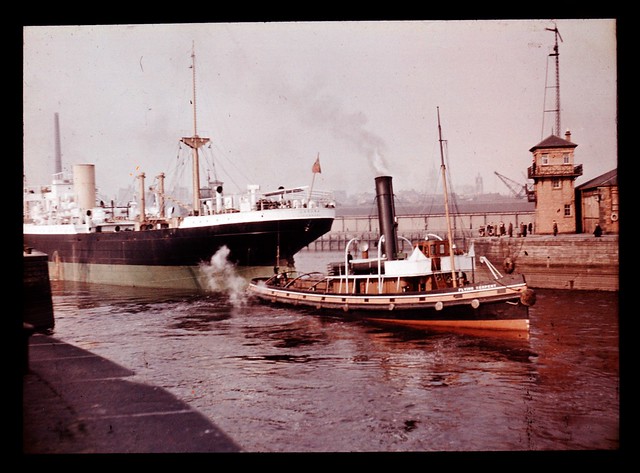
More images have been added to our Dan McDonald collection on Flickr, including this one of the tug Flying Serpent pulling the cargo ship Laguna into port at the James Watt Dock in Greenock.
The Flying Serpent was built by Ferguson Shipbuilders and launched from their yard at Port Glasgow on 16 March 1909 and then completed in 1911. It was owned by the Clyde Shipping Company and it's job was to pull large ships and help them navigate the bends in the River Clyde, ensuring that they kept to the deep channels. In it's lifetime it guided many ships including the Cunard Line's famous ocean liner the Aquitania. In May 1914, together with tugs the Flying Buzzard, Flying Falcon, Flying Linnet, Flying Cormorant and the Flying Swallow, the newly built Aquitania was pulled from John Brown's Shipyard at Clydebank, down river into the deeper waters of the Clyde Estuary, from where it went on course to Liverpool for it's maiden voyage to New York.
In the above photograph the tug is pulling the 6,466 ton, 420 foot long ship Laguna, which was built at the Harland & Wolff shipyard in Govan. It was launched on 19 April 1923 and completed in July the same year. The Laguna was a cargo ship owned by the Pacific Steam Navigation Company Ltd., Liverpool and like many cargo ships, was important in transporting essential supplies to the UK from America during the second world war. On the 31 May 1942, the Laguna picked up 17 survivors who had been adrift in a lifeboat for 3 days after their merchant ship the Yorkmoor had been sunk by a German U-Boat about 530 miles east of the Florida coast. Less than 3 months later the Laguna itself was torpedoed by a U-Boat. It was part of a convoy and was carrying cereals, cotton, hemp and ore from Cristobal in Panama to Liverpool, and was west of Haiti when it was hit. Two of the ships in the convoy were sunk but luckily the Laguna was only damaged and all the crew survived. It was towed to Guantanamo where it was repaired and returned to service in November 1942 and continued in working service until it was scrapped in 1952 at Barrow in Furness. The Flying Serpent outlasted it, being sold to Ybarrola Depositos Aceite Conbustible SA, Ceuta, in 1947 and ending the final 12 years of it's life in Spain.
Have a look at the other interesting images of our shipping heritage in the Dan McDonald Collection.
Kirsty Menzies, Volunteer
Several photographs from the William Lind Collection (held at the Ballast Trust) have been digitised and added to our Flickr account. The recent updates include two photographs of the S.S. Columbia, pictured below.
The S.S. Columbia's eventful history tells a tale of the increasing popularity of transnational travel and of conflict between world powers at the turn of the century.
Built for the Hamburg American Line by Laird Brothers of Birkenhead in 1889, the ship was sold to the Spanish government in 1898 for use as a troopship in the Spanish-American War. During its time under Spanish ownership it was named "Rapido". One year later it was sold back to the Hamburg American Line and returned to its original name. The Columbia was then sold to the Russian Voluntary Fleet in 1904, becoming the cruiser "Terek". It was used for troop transport during the Russo-Japanese War, before being scrapped in 1907.
You can view the merchant shipping album, and many other fascinating images, by clicking the link to our Flickr page below.
~ Joseph Heffernan, Volunteer
I am currently volunteering at the Ballast Trust where I have begun scanning and uploading some of the merchant shipping photographs held at the Ballast Trust from the William Lind Collection.
The picture below depicts one of the photographs from the William Lind collection.
This is the S.S "Amerika" built by Harland & Wolff, Belfast, in 1905. Her story begins in 1910 where "Amerika" was the first ship to carry an extra-tariff restaurant, created by Charles Mews's of Ritz Carlton fame.
In 1912 she transmitted an iceberg warning just hours before the RMS Titanic struck the fatal iceberg that caused it to sink. In 1914, with the outbreak of WW1, "Amerika" hid in Boston util the Americans entered the war where she was renamed "America", and carried troops across the Atlantic.
Check out the Ballast Trust's flicker account for more photographs and other interesting stories by clicking the link here.
~ Joanne Savage, Volunteer
The picture below depicts one of the photographs from the William Lind collection.
This is the S.S "Amerika" built by Harland & Wolff, Belfast, in 1905. Her story begins in 1910 where "Amerika" was the first ship to carry an extra-tariff restaurant, created by Charles Mews's of Ritz Carlton fame.
In 1912 she transmitted an iceberg warning just hours before the RMS Titanic struck the fatal iceberg that caused it to sink. In 1914, with the outbreak of WW1, "Amerika" hid in Boston util the Americans entered the war where she was renamed "America", and carried troops across the Atlantic.
Check out the Ballast Trust's flicker account for more photographs and other interesting stories by clicking the link here.
~ Joanne Savage, Volunteer
More images from the paddle steamer album have been added by our Project Scotland volunteeer this week to Flickr. Including this one of the Windsor Castle built by Caird & Co, Greenock, circa 1860.
Edit: Apparently the Caird & Co ship was built in 1859 and sank in 1860; since we have another photo of this ship dated 1889 (though we don't know when or how that date was attached), this may be a different Windsor Castle - most likely the 1875 ship built by Thomas B Seath of Rutherglen.

There is a model of the 1859 Windsor Castle on display in the McLean Museum, details here.
Edit: Apparently the Caird & Co ship was built in 1859 and sank in 1860; since we have another photo of this ship dated 1889 (though we don't know when or how that date was attached), this may be a different Windsor Castle - most likely the 1875 ship built by Thomas B Seath of Rutherglen.
There is a model of the 1859 Windsor Castle on display in the McLean Museum, details here.
Today's photo is one which caused me some confusion this week! I'm the Project Scotland volunteer who's been scanning old photos of paddlesteamers. Usually, after scanning a photograph, I look up the ship in one or two places, such as the Clydebuilt database, and find a little information to put on our flickr. Not this one, however.
It looked to me like a very early paddle steamer, and I was quite put out at not being able to find anything. At first I thought the name written beside it was wrong - the second word didn't look like Maid to me - but my eyes deceived me, and Scottish Maid was indeed the name. Staff member Duncan took a look as well, and he recognised that the photograph was taken from Gourock Pier, with Kilcreggan in the background.
Unfortunately for my searching, Scottish Maid is also the name of the first clipper ship, and she dominated the initial search results.
One item caught my eye, though: a genealogy forum. The original post was from an Australian, looking for information on his great-great-grandfather from Port Glasgow, who was lost at sea. Further down the page was a paragraph from the Glasgow Herald about that very man's death in 1863 after falling from "the Tug-Steamer Scottish Maid" in Port Glasgow harbour. Port Glasgow is not very far from Gourock - surely it was the same boat?
Searching for "Scottish Maid tug" brought me immediately to Tyne Tugs which lists four tugs under the name; but only one of them was registered at Port Glasgow.
So, this is - most likely - the wooden tugboat Scottish Maid, built by J Dowey of North Shields, in 1846. She was registered at Port Glasgow in 1853, and stayed on the Clyde until she was broken up in 1873.
Update: New information has come my way, that another of those four tugs was based at Greenock from 1877 to 1892. This was the Scottish Maid built in Gateshead in 1856.
Simply thinking about the development of photography, it's probably more likely to be the later boat; we may never know for sure...
It looked to me like a very early paddle steamer, and I was quite put out at not being able to find anything. At first I thought the name written beside it was wrong - the second word didn't look like Maid to me - but my eyes deceived me, and Scottish Maid was indeed the name. Staff member Duncan took a look as well, and he recognised that the photograph was taken from Gourock Pier, with Kilcreggan in the background.
Unfortunately for my searching, Scottish Maid is also the name of the first clipper ship, and she dominated the initial search results.
One item caught my eye, though: a genealogy forum. The original post was from an Australian, looking for information on his great-great-grandfather from Port Glasgow, who was lost at sea. Further down the page was a paragraph from the Glasgow Herald about that very man's death in 1863 after falling from "the Tug-Steamer Scottish Maid" in Port Glasgow harbour. Port Glasgow is not very far from Gourock - surely it was the same boat?
Searching for "Scottish Maid tug" brought me immediately to Tyne Tugs which lists four tugs under the name; but only one of them was registered at Port Glasgow.
So, this is - most likely - the wooden tugboat Scottish Maid, built by J Dowey of North Shields, in 1846. She was registered at Port Glasgow in 1853, and stayed on the Clyde until she was broken up in 1873.
Update: New information has come my way, that another of those four tugs was based at Greenock from 1877 to 1892. This was the Scottish Maid built in Gateshead in 1856.
Simply thinking about the development of photography, it's probably more likely to be the later boat; we may never know for sure...
Donaldson
Shipping Line
Recently
catalogued is material which The Ballast Trust had received from William Lind in connection with the Donaldson
Shipping Line. It contains private papers, legal documents and private and
company photographs, many of which were used in the centenary history The Donaldson Line by Alastair M.
Dunnett (Glasgow :
1960). It will be given to the Glasgow City Archives at the Mitchell Library in
due course and added to their Donaldson Line archive (Pressmarks
TD49/127-TD49/294).
The Donaldson Line
The
Donaldson brothers, John and William, began working together in the 1850s as ship-brokers and eventually turned to ship owners with their first ship the
wooden sailing barque Joan Taylor,
named after the Captain’s niece, in 1858. The brothers were to become very
successful and wealthy as they exploited the new South American trade markets.
As the company expanded they moved into providing both passenger and cargo
shipping, such as opening major routes to ![]() |
| Logging and paper making Newfoundland, Canada. The lower right photo shows rolls of paper being loaded onto the SS Tritonia. Photograph Album TD49/262. |
The company acquired other
lines and developed subsidiary companies. Though after the Second World War
they continued their passenger and cargo lines, decline was beginning to set in
due to the increased passenger air transport and the containerisation of cargo.
Ultimately the Line went into liquidation in 1967.
This
additional material contains many documents related to the forming and merging
of the various Donaldson companies between 1920 and 1949, including the various
proposals, financial summaries and share allocations.
![]() |
| TSS Saturnia postcard Photograph Album TD49/263 |
Of course there is a good deal of ship information. Original documents are present giving costs and specifications of various vessels between 1860 and 1870; and ship records and log books between 1885 and 1918. There are also specific logs for the Donaldson’s first vessel, Joan Taylor (1858-59), the Astarte (1870-71), and the Colorado (1872-79). There are over 50 photographs of various vessels, two photograph albums, and over 30 photographs of events and people. There are also plans with specifications of a selection of vessels, including a line drawing of the steamship Colina (I) built in 1872.
![]() |
| Menu from the TSS Saturnia 1913 Photograph Album TD49/263 |
Ship events, newspaper cuttings and other ephemera are also in the collection, including postcards that passengers could send during their voyages. The example is from the steamship Saturnia built in 1910. It sailed between the Clyde and Canada - Portland, Me., or Saint John, N.B., and Halifax, N.S. in the winter. It carried 250 cabin passengers and 950 emigrants. It hit an iceberg in 1921 homeward bound off the Newfoundland Coast but was able to complete the voyage. It was sold as a whale factory ship in 1928.
Additionally
there are notes and proof copies of the centenary history, including examples
of the coloured photoengraved plates from Gilchrist Brothers Ltd., printers in Leeds .
Stephen
Hall
![]() |
| Maranon c1868: Photoengraved image Photograph Album TD49/263 |
Today's photo is from our Dan McDonald Collection and is of the TS Queen Mary II. She was built by William Denny and Brothers, Dumbarton for Williamson-Buchanan in 1933.
This image appears on the last page of our history which was posted out this week and published online here. It was chosen to go opposite the page with details of all the many volunteers who have worked with the Ballast Trust over the years and who we'd like to say a big thank you to!!
I'm delighted to be able to share the official Ballast Trust history. This has been published by the Trustees to mark and celebrate the 25th Anniversary of the Ballast Trust.
We are sending hard copies out in the post this week to organisations and individuals we have worked with over the last 25 years, our volunteers and other relevant organisations. But this online version also means that we can share our beautifully designed history* with other interested parties.
While December 2012 was the 25th anniversary of the official Trust deed being set up, the operations of the Ballast Trust really got going throughout 1988 when work begun on the huge job at Port Glasgow to process the Scott Lithgow records. So for this reason, throughout 2013, we'll be tweeting extracts from Bill's diaries to try and get a sense of what the Trust was doing in its first full year of operations (mainly sorting and rolling lots of plans!!).
*Our history was designed and printed by Resolve Creative.
We are sending hard copies out in the post this week to organisations and individuals we have worked with over the last 25 years, our volunteers and other relevant organisations. But this online version also means that we can share our beautifully designed history* with other interested parties.
While December 2012 was the 25th anniversary of the official Trust deed being set up, the operations of the Ballast Trust really got going throughout 1988 when work begun on the huge job at Port Glasgow to process the Scott Lithgow records. So for this reason, throughout 2013, we'll be tweeting extracts from Bill's diaries to try and get a sense of what the Trust was doing in its first full year of operations (mainly sorting and rolling lots of plans!!).
*Our history was designed and printed by Resolve Creative.
The Friday photo returns after a shamefully long absence!
Things have been pretty busy recently with collections coming and going but we have a wonderful new volunteer who is going to scan in photographs from Bill's own collections which are an assortment of shipping and engineering images he collected.
The first batch come from a drawer entitled 'Clyde and West Coast' and some have very minimal descriptions or none at all so there's a bit of guess work in the descriptions they've been given on Flickr. However, within a day of them being uploaded my comments about the great Flickr community came true and we had updates and comments on a few of them.
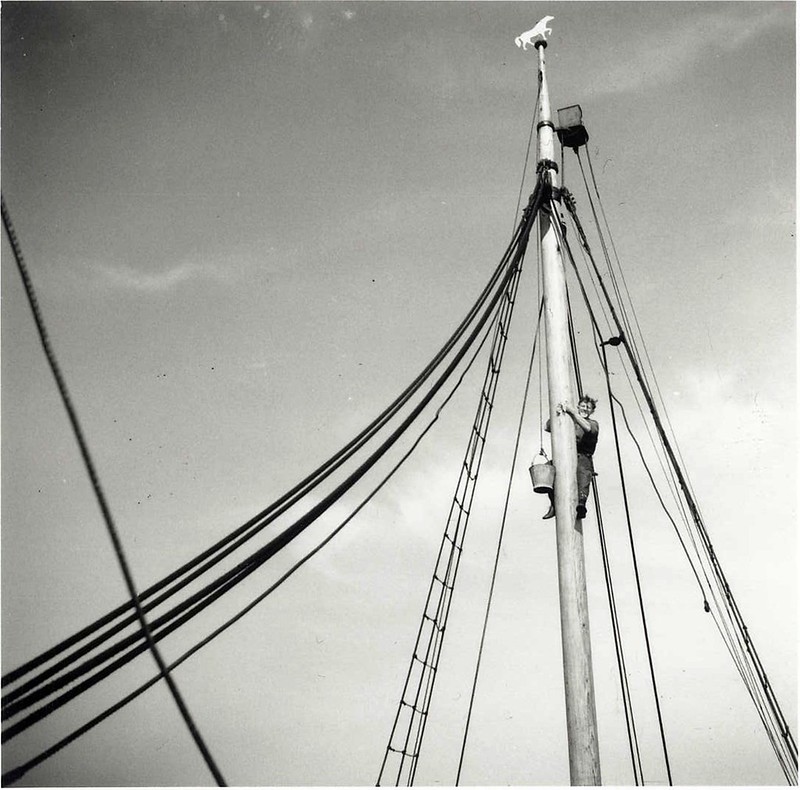
The image I've chosen for today is of the mast of the SS Pibroch, the puffer built by Scotts of Bowling in 1923 which served the Caol Ila distillery on Islay. We had initially labelled this image as 'unknown ships mast' but it was very quickly pointed out to us that the white horse on the top of the mast indicated that the ship belonged to the White Horse Distillers. The puffer was originally built for the Mackie Brothers, owners of the White Horse Distillery at Lagavulin.
You can see more images of the Pibroch in action here and there is information about her and the Caol Ila distillery here.
The George Stewart & Co Ltd, Manufacturing
Stationers Collection, has now been catalogued and will be sent to the
Edinburgh City Archives (Reference number SL247).
George Stewart & Co Ltd were founded in 1879
by George Stewart, but it was his youngest son, Alastair M. Stewart (b. 1905),
who steered the company through the 20th century. This collection
represents all that has survived from the long history of this Edinburgh
Company. The reasons for this are numerous, but possibly the serious fire
in August of 1950 destroyed much of their corporate and historical records; but in the surviving material are still important archival and historical records. The business records include two minute books, two finance books, share information and
profit and loss reports. There are are notebooks detailing costs of materials and basic job work.
Additional to the business records, the Collection also has material relating to the social activities of the workforce, identifying a camaraderie that was evident in many family-owned firms of the time. Minute and record books of the Company bowling, golf and rambling clubs demonstrate highly active groups and provide an important contribution to local sports history.
For example, The Bowling Club was a
member of the Edinburgh and Leith Printing Establishments Bowling Club
Association, and it competed in both League and Single-hand competitions, winning
several. The Rambling Club book contains information on local excursions,
including various events such as local Burns dinners with
accompanying ephemera.
Though Stewart & Co. were manufacturing stationers, they were closely involved with the printing industry. The Chairman, Alastair M. Stewart, was an important figure within the printing trade and served in a number of important positions, including Vice-President (from 1965) and then as President of the Federation of Master Printers (1966-67).
The archive has interesting ephemera from this period from a number
of British and international printing associations and newspapers, related to
conferences and dinners, including photographs, that Alastair M. Stewart and
his wife attended.
In
connection with Edinburgh , Alastair M. Stewart
was also a Director of the Edinburgh Chamber of Commerce and an Assistant of
the Company of Merchants of the City of Edinburgh .
The Company celebrated its 100 years in 1979, and there are documents connected with the event in the Collection, unfortunately no souvenirs seem to have survived: the Parker Pen, photographs, nor their “First Hundred Years” publication which was produced specially for the event. If any of these items exist, or even other papers or materials related to the firm, Edinburgh City Archives or the Ballast Trust, would appreciate being able to add these to this important Collection for future generations.
Stephen Hall
![]() |
| Business records |
Additional to the business records, the Collection also has material relating to the social activities of the workforce, identifying a camaraderie that was evident in many family-owned firms of the time. Minute and record books of the Company bowling, golf and rambling clubs demonstrate highly active groups and provide an important contribution to local sports history.
![]() |
| Stewart Rambling Club 1889-1905 (SL247/3/1/1) |
accompanying ephemera.
![]() |
| Stewart Golf Club 1902-1903 (SL247/3/3/1 |
Though Stewart & Co. were manufacturing stationers, they were closely involved with the printing industry. The Chairman, Alastair M. Stewart, was an important figure within the printing trade and served in a number of important positions, including Vice-President (from 1965) and then as President of the Federation of Master Printers (1966-67).
![]() |
| Printers’ Association Events 1965-66 (SL247/6/1) |
![]() |
| Printers’ Association Events 1967 (SL247/6/2) |
Unfortunately
the firm fell victim to a final salary pension scheme, that, like so many
others, had created an "impossible to fund" arrears. The directors
had tried to restructure the business and its funding and had been making good
progress, but were unable to find a solution for their major creditors. The
company went into administration on 6 December 2011.
The Company celebrated its 100 years in 1979, and there are documents connected with the event in the Collection, unfortunately no souvenirs seem to have survived: the Parker Pen, photographs, nor their “First Hundred Years” publication which was produced specially for the event. If any of these items exist, or even other papers or materials related to the firm, Edinburgh City Archives or the Ballast Trust, would appreciate being able to add these to this important Collection for future generations.
Stephen Hall
Today's Friday photo is an image of the Mairi Bhan a fishing vessel built in Fraserburgh in 1933 and registered in Wick as vessel WK176.
This is one of the negatives that our volunteer Helen has recently finished added to the excel catalogue we have for our Dan McDonald collection. For some reason the fishing vessels and ports weren't on the original excel spreadsheet. This has now been remedied and you can download or view the catalogue from our collections page on the website.

It is a lovely collection of images of boats and ports like the fishing port of Pennan near Fraserburgh.
This is one of the negatives that our volunteer Helen has recently finished added to the excel catalogue we have for our Dan McDonald collection. For some reason the fishing vessels and ports weren't on the original excel spreadsheet. This has now been remedied and you can download or view the catalogue from our collections page on the website.
It is a lovely collection of images of boats and ports like the fishing port of Pennan near Fraserburgh.
The Ballast Trust is working with ProjectScotland to create a volunteering opportunity for a young person to give them an opportunity to an understanding of archives as a career and the role of an archivist.
The placement can be viewed on their website by searching here using our postcode PA5 8AB.
T: 08458 4 16 2 25
HQ: 20 Hopetoun Street, Edinburgh, EH7 4GH
It will provide suitable experience with which to be accepted for further training in the profession and relevant experience for those considering other jobs in the heritage and information sectors.
The main duties of the placement will cover some/all of the following:
E: info@projectscotland.co.ukThe main duties of the placement will cover some/all of the following:
- Describe and reference items (from a collection of architectural and technical drawings from the 19th and 20th century or a personal collection of ship photographs and slides.)
- Package and move records as required.
- Boxlist collections of records (from a marine engineering company and/or a company of boiler makers).
- Research and answer enquiries using our reference library and online sources of information.
- Digitise selections of photographs and upload them to our flickr pages
- Write blog posts for here to provide updates on your work and project progress
- Digitise a collection of headed notepaper from the 19th and 20th century and upload to and provide descriptions for flickr.
If you are interested or know any young people who might be interested in gaining valuable work experience then please contact ProjectScotland:
T: 08458 4 16 2 25
HQ: 20 Hopetoun Street, Edinburgh, EH7 4GH
It is with great sadness that we have to report the death of Graham Robinson, a volunteer with the Ballast Trust. Graham had worked as a volunteer for 10 years and was a valued colleague and friend.
During his time with us he applied his many technical skills to the identification and listing of the Grahame E Langmuir collection of railway photographs which is now held at the Mitchell Library. More recently he had completed over 5 years of work to separate, rebuild and list a large collection of British Rail negatives and slides on behalf of the National Archives of Scotland.
This was a substantial project that relied heavily on Graham’s amazing powers of identification, particularly as much of the collection was from the later 20th century after the Beaching cuts when a large amount of signage disappeared making identification more difficult. Graham’s hard work has resulted in 98 boxes being completed which contain nearly 35,000 items.
He will be sorely missed by us all.
During his time with us he applied his many technical skills to the identification and listing of the Grahame E Langmuir collection of railway photographs which is now held at the Mitchell Library. More recently he had completed over 5 years of work to separate, rebuild and list a large collection of British Rail negatives and slides on behalf of the National Archives of Scotland.
This was a substantial project that relied heavily on Graham’s amazing powers of identification, particularly as much of the collection was from the later 20th century after the Beaching cuts when a large amount of signage disappeared making identification more difficult. Graham’s hard work has resulted in 98 boxes being completed which contain nearly 35,000 items.
He will be sorely missed by us all.
Our Volunteer Policy was approved by the Trustees yesterday so we now have an official statement of what we can offer volunteers and what we would expect from them.
We're very fortunate to have three great volunteers already at the Trust who between them must know everything there is about railways and locomotives. However, we still have plenty of work for new volunteers and we can offer great experience in handling technical records, whether you are interested in a career in archives or helping to preserve Scotland's industrial history.
More information about the type of projects we have is available on our website.
We are looking for people with the following:
- Time to spare - this could be as little as a couple of hours a week or daily attendance (within office hours).
- Attention to detail - the records require accurate and detailed listing.
- Willingness to learn - we have set procedures for processing records.
- A knowledge of something (ships, trains or engines) is necessary for some of our collections - we like to match collections to specialist knowledge where possible.

In return we can offer:
- All the tea and chocolate biscuits you can manage!
- A chance to socialise with friendly individuals.
- Training in computers and specific IT software if you wish.
- The opportunity to help preserve Scotland's industrial past.
If you are interested please contact Kiara King (email: k.king@archives.gla.ac.uk or by telephone: 01505 328488). Or download and complete our application form and send it back.
At the beginning of the year the National Council on Archives carried out a survey of volunteers in archives, which 3 of the volunteers with the Trust completed surveys for. Because of the unique nature of the Trust's operations it was suggested that we would make a good case study for the report as an example of using specialist expertise.
The report has just been published on the NCA's website here.


.jpg)