This week's Friday Photo is a copy of a line drawing of 'Coriolanus' a 3 masted iron ship, built by Archibald McMillan & Son in Dumbarton. It was built in 1876. This lovely plan, found by our volunteer Craig Osborne, is part of the Phil Thomas collection. Below are some images of the ship, where the detail on the plans can be clearly seen. The ship was laid up in 1932.
One of our most popular and favourite'd images on Flickr is 'Atlantic Locomotive'. Built by Andrew Barclay & Co. in 1907 for the Campbeltown and Machrihanish Light Railway (Type 0-6-2 T. Works number 1098.)
The records of Andrew Barclay & Co. are held at the University of Glasgow Archives and Special Collections. Find out more about the Campbeltown and Machrihanish Light Railway. Records suggest that the locomotive livery was olive green lined out in black and yellow.
~ Jennifer Brunton, archives assistant (graduate trainee).
Ref: DC188-1-6
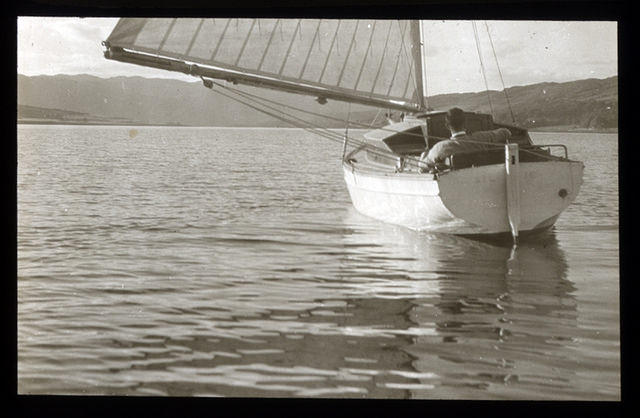
This week's Friday Photo is from our Dan McDonald collection. 'Ailie' was Dan's yacht, purchased in 1925 along with his friend, Andrew Roulston. Ailie was refitted at Port Bannatyne and was used for regular weekend and holiday sailing.
Ref: DC188-1-21
The Dan McDonald collection which is comprised of over five thousand negatives, each documenting the activity and latter inactivity on the River Clyde over a period of forty years, capturing what is arguably one of the most important periods in terms of Scotland's Shipbuilding Industry.
However, the change in how Dan captures Ailie is quite interesting. Following their wedding, in 1930 both Dan and his wife used Ailie to explore the sea lochs in the Clyde area, and elsewhere. The intimate nature of these images is reflective of Dan's relationship to this yacht, clearly holding so many personal and cherished memories.
Ref: DC188-1-22
Ref: DC188-1-29
~ Jennifer Brunton, archives assistant (graduate trainee).
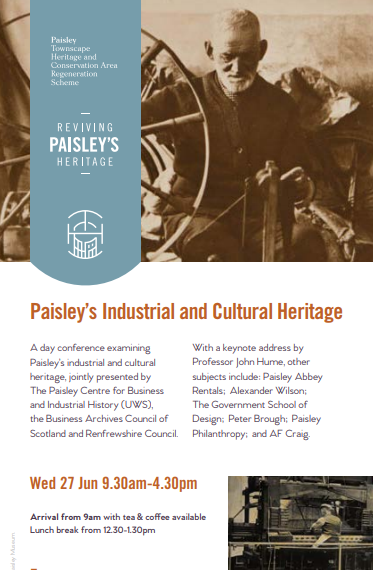
This week I attended 'Paisley's Industrial and Cultural Heritage Conference' held at Paisley Town Hall. This day long conference was presented jointly by The Paisley Centre for Business and Industrial History (UWS), the Business Archives Council of Scotland and Renfrewshire Council and was supported by Paisley Townscape and Heritage and Conservation Area Regeneration Scheme (TH.CARS2) funded by the Heritage Lottery Fund, Historic Environment Scotland and Renfrewshire Council.
Talks throughout the day covered topics from the the making of the Paisley Shawl, Paisley Abbey Rentals, Alexander Wilson, The Government School of Design, Peter Brough, The Hugh Smiley Nursery, Paisley Philanthropy and AF Craig.
Each talk provided a unique celebration of Paisley's rich and vibrant history, reflecting the significance of Paisley's industrial and cultural heritage, not only of its importance within Scotland and the UK but also on an international level.
The Ballast Trust and Business Archives Council of Scotland also had tables set up to spread the word on Business Archives!
A really fantastic and informative day!
~ Jennifer Brunton, archives assistant.
The crucial role of female workers within the shipping, manufacturing, and engineering industries has become more visible recently with campaigns and online content created by University of Glasgow Archives and Special Collections, Glasgow Women’s Library, Go Industrial, Inverclyde Shipbuilding and Engineering and Imperial War Museum alongside other institutions that seeks to understand, identify and raise awareness of the important role women played within Scotland’s Industrial history.
My initial inspiration to write a blog post focusing on 'Women at Work’ came after conversations with colleagues on females working in the shipyards and in engineering firms which led me to find out more about the role of female tracers. The image above is of the tracing department at Fairfield’s Shipbuilding and Engineering Company in Govan c.1909.
Female tracers worked in the drawing offices and traced over the drawings made by draftsmen to make the final original design. The need for tracers is often put down to the increased demand for engineers, however it was mainly down to the fact that women were able to trace over these plans with care and precision, it took great skill to be able to become a tracer.
To become a tracer, you would have to complete an apprenticeship in a tracing office. The length of these apprenticeships seems to vary between companies but range from nine months to five years. The tracing offices were made up of female employees who were very much kept separate from their male colleagues or draftsmen.
The above image shows the drawing office where draftsmen would have completed their plans before sending them though to the tracers. Despite men and women being kept separate both workrooms are similar in layout and there aesthetic. This image was also taken at Fairfield’s Shipbuilding and Engineering Company in Govan c.1909.
I was fortunate enough to be put in contact with Ann Wilson who had previously completed a nine-month apprenticeship with Loudon’s engineering shop in Paisley and had then gone on to work with the G.P.O (general post office) for 29 years as a tracer. In this blog I have recounted her time spent as an apprentice and then as a tracer to give more information on the job and what was involved.
Tracers worked solely with ink and linen cloth. Once the cloth had been stretched using four pins, chalk was rubbed into the warp and weft of the linen and left overnight. In the morning the plan drawn by the draughtsman would be slid under the cloth and then weighted. In shipbuilding, plans came in two different sizes; 32” and 46”. Tracers would sometimes work together to complete a drawing if necessary.
The use of linen, as Ann recalls, was a difficult material to work with. Using chalk before applying the ink would provide a surface texture making it easier to apply. The tools used were also the same tools used by draftsmen. If too much ink was placed into the pen it would run onto the linen and spoil the drawing. However, the time it took for the ink to dry would have been minutes as it was applied finely onto the linen. The boards used were tilted at an angle towards the tracer, an office could have up to twenty tracers working in the offices at one time. These boards could be adjusted and set flat depending on the need of the tracer. Set-squares, straight edges and curves were all crucial parts of the tracer’s toolkit, often straight lines were drawn first with corners added in afterwards.
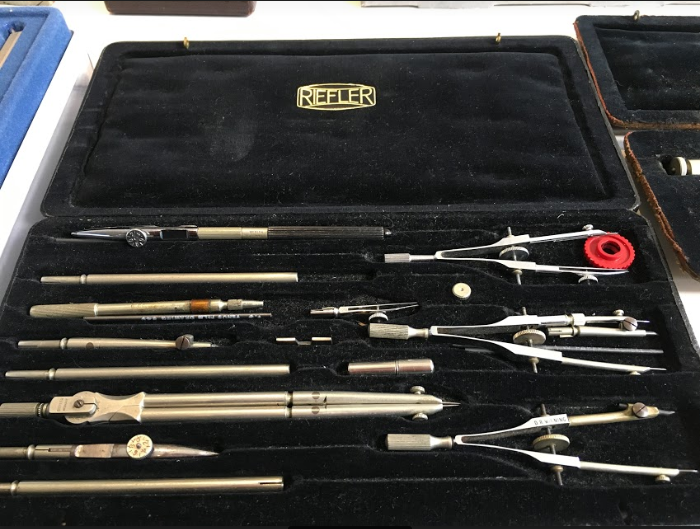
We were also fortunate to find some tracers tools which had belonged to Duncan Winning. These would have been used by both draftsmen and tracers.
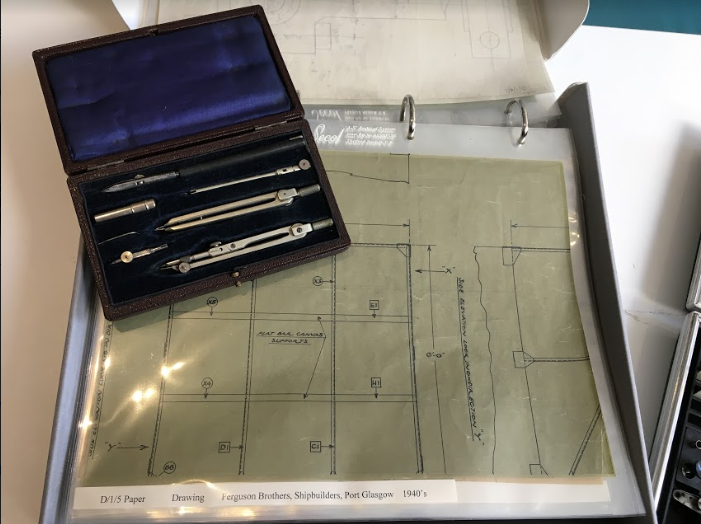
One of the most useful resources at The Trust is a folder compiled by Duncan for the National Records of Scotland which documents the different types of materials that would have been used for plans. This folder is an invaluable resource when cataloging large rolls of plans made up of different types of material, for example; plastic, cartridge, paper and linen. The image below shows a paper drawing from Ferguson Brothers Shipbuilders, Port Glasgow next to a set of tools that a tracer would have used to draw a similar plan.
Not every plan was simply a straightforward copy, at times tracers were required to add in adjustments or alterations, this included making one drawing from multiple plans; each dependant on what the individual order demanded. Many drawings required different levels of detail which the tracer would build upon until the full drawing was completed.
Thanks to Ann Wilson and Craig Osborne our volunteer for sharing their knowledge on the work of female tracers.
Links and References
- The Girls Own Paper, 1880-1907 ed. Terri Doughty. Broadview Press, March 2004.
- Go Industrial, Women at Work on the Clyde blog post.
- Go Industrial Collections.
- A Girl's Career, Glasgow Women's Library.
- WW1 - Women in Shipbuilding. Inverclyde Shipbuilding and Engineering.
- The Women's Work in the Transport Services, Imperial War Museum Collections.
- A Day in the Life of a Munitions Worker, Imperial War Museum.
- The Glasgow Story, Drilling at Linthouse Shipyard. Image from Glasgow University Archive Services.
- Women's History Scotland.
- Scottish Archives for Schools, The Role of Women in Industry.
Bill Lind was a ship enthusiast and built up a large personal collection of plans, photographs, and postcards. This week’s photo is of tanker ‘Stolt Norness’ built by Boelwerf (c.1970) in Temse, Belgium. This image comes from Bill’s personal postcard collection, an important and invaluable resource for us when answering enquiries and carrying out research into ships. She was sold in 1977 and again in 1982 and renamed ‘Turpial.’
The Ballast Trust and Duncan in particular, was involved since late 2010 in working with Patricia Cain to understand the processes of technical drawing within shipyard offices using some of the collections we have here and Duncan's own knowledge of technical drawing.
This has been a very interesting process and new experience for us and the exhibition Drawing (on) Riverside opened at Kelvingrove Museum last month on 14 April and will be available until August. From the Kelvingrove site:
Patricia Cain is the Glasgow-based lawyer turned artist who recently won both the prestigious Threadneedle Prize and the Aspect Prize for her forensically detailed studies of the construction of Glasgow's Riverside Museum. Now she brings these studies together in Drawing (on) Riverside, an exploration of the different phases of the museum's construction, through the mediums of drawing, painting and sculpture.Patricia collaborated with others to create the exhibition and this video from Ann Nisbet's blog tells you more about the process of the construction of the architectural installation part of the exhibition.
Congratulations to artist Patricia Cain who was awarded the Threadneedle Prize for her work 'Building the Riverside Museum'. Some images of her work are available here.
Patricia has visited the Ballast Trust recently to discuss the processes of construction with Duncan and look at some of the images we have in the Lind collection of shipyards and the construction of large liners.
More information is available from the Threadneedle press release:
Patricia Cain trained as a lawyer before becoming a fulltime artist in 2004, going on to complete her PhD at Glasgow School of Art. She lives and works in Glasgow, and her work is focused largely on regeneration of the city. Building the Riverside Museum explores the physical construction of the Glasgow Riverside Museum of Transport, designed by architect Zaha Hadid. Cain uses pastel, often considered a difficult medium, to create large-scale industrial drawings, where broad and confident lines of colour build a structure into the work that replicates its subject matter. Earlier this year, Cain won the Aspect Prize 2009/10.