
Bill Lind was a ship enthusiast and built up a large personal collection of plans, photographs, and postcards. This week’s photo is of tanker ‘Stolt Norness’ built by Boelwerf (c.1970) in Temse, Belgium. This image comes from Bill’s personal postcard collection, an important and invaluable resource for us when answering enquiries and carrying out research into ships. She was sold in 1977 and again in 1982 and renamed ‘Turpial.’

Having watched the Waverley pass by my house for many years, it is one of the most distinctive memories I have of growing up on the Clyde. Often seeing ships, boats and tugs of all kinds sailing past, bound for unknown destinations. The Waverley in particular was a regular sight and one which, as a child, I could easily spot with its distinctive black, white and bright red funnels. It therefore seemed appropriate to be the first in our new series of 'monthly favourites' on the blog. As the Waverley sails between April and October each year, it also serves as a reminder that spring is here and that summer *fingers crossed* is not much further away!
Named after Sir Walter Scott's first novel, the Waverley was built by A&J Inglis of Pointhouse in 1947 and is the last sea-going paddle steam engine in the world. Ending her working career for the London and North Eastern Railway in 1975 the Waverley has since been in operational preservation, offering regular trips on the Clyde, the Thames, South Coast of England and the Bristol Channel.This picture is part of our Dan McDonald collection, which contains over 6,500 images of boats and vessels along the Clyde and the west coast of Scotland between 1920 and 1980.
The importance of paddle steamers is reflected in the story of the Waverley, famously gifted to the Paddle Steamer Preservation Society for £1. Not only did paddle steamers hold a crucial place in coastal passenger and excursion trade, they also made a significant contribution to the war effort as minesweepers in both World War 1 and World War 2. The Waverley was built to replace the previous Waverley which played an important role at Dunkirk in 1940.

The first Waverley was built in 1899 also by A&J Inglis. This particular image is part of the Lind collection, made up of Bill's personal collection of ship plans, photographs and postcards. The original Waverley was requisitioned during the first World War and deployed as a minesweeper in 1915. During the evacuation at Dunkirk in 1940 the boat was sunk during an air attack.
In 2003, a large-scale restoration project began to return the Waverley to its original 1940's style. All made possible by funds from National Heritage Lottery Fund, PSPS with contributions also coming from Glasgow City Council, Scottish Enterprise Glasgow, the European Regional Development and local authorities. Not to mention the countless number of devoted volunteers and specialists who all contributed to the successful completion of the project. This important restoration re-affirmed the Waverley's importance within Scottish Heritage and paddle steamers as being of national significance.
These images provide a way of understanding Scotland's shipping industry whilst providing accessibility through digitisation of these images.
References and useful links.
This week
our #ArchiveZ tag was 'H' in the alphabet and it seemed only
appropriate to document the move of the Trust to its current
headquarters in Johnstone. On this day 26 years ago, archival work
commenced at the Ballast Trust's new headquarters in Walkinshaw
street, Johnstone. The move was completed earlier in March 1992, a
task which took 3 days!
Prior to
moving to Johnstone, the Trust had initially operated from Bill's
base at Malcolm's of Brookfield, however this was only a temporary
arrangement. The liquidation of Scott Lithgow shipyard saw the Trust
begin a large-scale operation to rescue and list the huge volume of
commercial and technical papers of the inoperative organisation. The
task was of such a scale it was agreed that all surviving records of
constituent companies would be centralised in the former Joiner's
Shop in the Kingston Yard. It was through this operation that the
Ballast Trust were able to secure a new headquarters for the next 3
years and 8 months, from 29th July 1988 to 19th
March 1992.

This is
part of a letter written by Bill to Henry Higgs, giving an update on
the move to Scott Lithgow's Joiner's Shop in Port Glasgow from the
offices in Brookfield. Dated 17th December, 1988.
Reference No. UGD 301/1/20/120.

This is a letter written by Bill to George Mackenzie at the Scottish Record Office. This is a progress report on the move and subsequent activities in Port Glasgow. Dated 12th August, 1988. Reference No. UGD 301/1/20/65.

This is
correspondence between George Mackenzie at the Scottish Record Office
and Bill Lind. Bill highlights the plan for Scott Lithgow's and gives
dates when the Trust would be ready to move to Port Glasgow. Dated
30th June, 1988. Reference No. UGD 301/1/20/49.
It was in
Port Glasgow that the working practices of the Ballast Trust
developed and the value and importance of its service came to be
fully understood and acknowledged. The enormity of this task is
apparent in Bill's correspondence, where he estimates over 120 tons
of material was collected from Scott Lithgow's and was brought to the
Joiner's shop for processing. This process culminated in a rich
collection covering a period of 120 years, including written
communication about the building of blockade runners on the Clyde
during the American Civil War, photo albums and a series of yard
manager diaries. These records were then transferred to the Scottish
Business Archive at the University of Glasgow by Glasgow University
Archive Services.
The
successful arrangement at Scott Lithgow also helped to secure the
agreement of Kvaerner Kincaid of Greenock, to clear the vast quantity
of commercial and technical records from their premises. A similar
set-up to Scott Lithgow was granted and Kincaid's allowed the Trust
access to the mould loft of the former shipbuilders. At this point
the Trust was operating from two independent locations
simultaneously.
However,
this came to an end in 1991, when Trafalgar House notified the Trust
of its intention to demolish the Joiner's Shop and clear the site at
the Kingston Yard. A new search for permanent premises led the Trust
to its present base in Walkinshaw Street, Johnstone.
The move
to Johnstone was a gargantuan task, which required two teams at the
Kingston Yard and at Kincaid's along with help from personnel at the
Scottish Records Office (now known as National Records of Scotland)
and Strathclyde Regional Archives (now known as Glasgow City
Archives) and students from Professor Slaven's Department of Economic
History in the University of Glasgow. The move began on the 16th
March 1992 and was completed by the 19th March 1992.

This
image shows the outside of the Trust in 1992. Ref UGD 301/6/3/8.

This
image is of Bill Lind in his office at the Ballast Trust, now the
office for our Archivist and Surveying Officer. Ref UGD 301/6/3/8.

This image
is of our central work area before any of the shelving was added. Ref
UGD 301/6/3/8.

This is correspondence between Bill Lind and Duncan Haws, Travel Creators
Ltd. explaining the Trust. Dated 8th March, 1994.
Reference No. UGD 301/1/26/35.
The premises
at Walkinshaw Street, previously a furniture factory of James E.
Robertson and Sons Ltd. suited the purposes of the Trust well.
Between 1992 and 2007 this was where Bill was able to shape his
personal vision for the trust and what was required to identify, list
and catalogue technical records in order for them to be accessible
and understandable to everyone.
This weekend marks the traditional start of the Glasgow Fair Fortnight and an appropriate time to share some of the wonderful images of paddlesteamers and later ships that were used by holiday makers to get away down the Clyde to the coast.


The ships shown above are Jeanie Dean, Glen Sannox, Waverley III, Lucy Ashton but there are lots more images here and a nice BBC article about the history of the Glasgow Fair here: Reliving Glasgow Fair Fortnight.
New merchant navy and warship images have been added to our Dan McDonald collection on Flickr, including this image, which shows the S.S. Melita being re-fueled with coal in 1924.
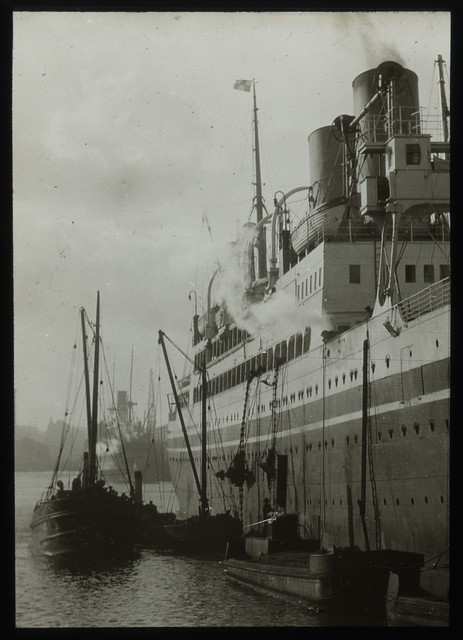
Built by Barclay, Curle & Co, Whiteinch in 1918, the Melita was originally intended for the German Hamburg-America Line (HAPAG), but at the outbreak of World War I the unfinished ship was sold to Canadian Pacific Railway Ocean Lines. Her main engines were built by Harland and Wolff, Belfast, who subcontracted her maiden voyage in January of 1918 from Liverpool to St John. At 13967 tonnes, and 520 ft by 67.2 ft, she was built to be a passenger ship, but was requisitioned by the Royal Navy as a troop ship to transport American soldiers to Europe. After the War, she helped return American and Canadian soldiers back across the Atlantic and German P.O.Ws back home before being placed on the Liverpool-Montreal run and the Antwerp-Southhampton-Montreal run.
After the Great Depression, the Melita was re-purposed as a cruise ship, travelling to the Canary Islands and the Mediterranean before being sold for scrap. Avoiding this fate, she was bought up by the Italia Line in 1935 and renamed the Liguria. She took part in the mass emigration initiative under Mussolini and transported Italian settlers to Libya, but was largely being used as a troop ship when she was scuttled in January 1941. Nine years later, she was raised and scrapped.
Thanks to this site, which provided much of the information for this post.
Olivia Howarth, archives trainee.
Throughout the 1800s the Firth of Clyde was populated by steamers. These ships were praised for their speed and would sail as far as Largs, Campbeltown and Inverary, taking holidaymakers to resorts and providing a commuter service for those travelling from holiday homes. They provided an integrated transport system, allowing for fast connections with the new railheads along the coast. The ships were often run by railway companies themselves and the vessels remained especially popular for leisure journeys until the 1960s. However, there were also smaller steamers that ran ferry services along the river, such as Clutha No 10.

Clutha No 10 was a steel screw steamer built by the Murray Brothers of Dumbarton in 1891. Together with No 9, the steamer was certified to hold up to 360 passengers, making them the largest capacity ferries in the fleet. Here we can see No 10 coming into dock at one of the eleven stops that were located either side of the Clyde.
Although the Cluthas began as a service of only six vessels in 1884, they quickly grew to be a fleet of twelve passenger ferries operated by the Clyde Navigation Trust. They ran a round trip service of about three miles from Victoria Bridge to Whiteinch and passengers were charged one penny per journey. The ladies’ cabin was available for an extra penny, and there was also smoking room.The small passenger steamers remained popular for nearly two decades, but were deemed unnecessary with the introduction of the subway in 1896 and the trams in 1901. The service was discontinued in 1903 and little is known about what happened to the Cluthas after this. No 10 was purchased by the Admiralty and transferred to the River Medway.
Thanks to this site, which provided much of the information for this post. New steamer images have been added to our Dan McDonald collection on Flickr.
Olivia Howarth, archives trainee.